Tuesday, March 12, 2013

Conclave: First day


My day!

Morning: since I was free from the events, I went to school.

12:30 pm I presided over the Mass for the election of the pope at the Casa Santa Maria. We wore red vestments and pray: O God, eternal Shepherd, who govern your flock with unfailing care,
grant in your boundless fatherly love a pastor for your Church
who will please you by his holiness and to us show watchful care.

Through our Lord Jesus Christ, your Son,
who lives and reigns with you in the unity of the Holy Spirit,
one God, forever and ever. Amen.

3:00 pm I couldn’t resist the growing anxiety about the conclave and so I went up to the Urbaniana University for a second day of a conference on penal law. The panelists were longer than ever! 


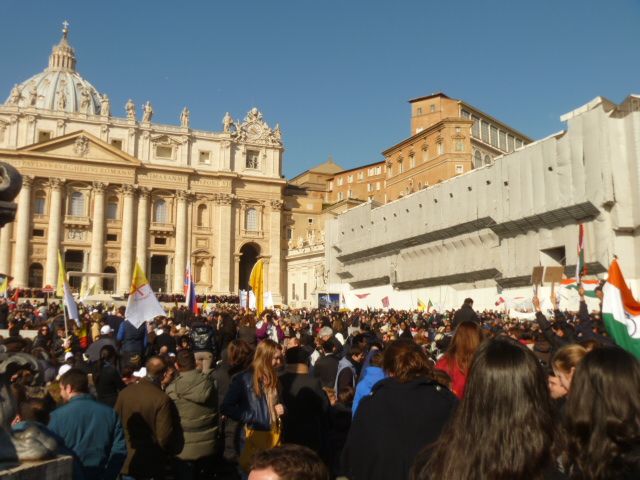
6:50 pm I finally went down to St Peter’s square. There were more cameras than umbrellas for the rain! Beautifully crowed and illuminated. It was like time is not passing. I didn’t know where to look, what to say. Yet, I talked like a parrot.

7:00 pm The sky was very dark, a good background for white. But I didn’t want the election to happen this early. We deserve DRAMA! An electric expectation covered me up and down. 


 7:15 pm I wondered why the chimney wasn’t actually illuminated and yet, it was through the screens around the square. It was not my problem, but I had to think on something randomly distracting.

7:16 pm My problem was the rain.

7:20 pm My problem is solved. It seemed there is not rain anymore. Or my umbrella is covering me well. I don care about that problem anymore. The square is getting crowder. I feel like in a page of a history book. I am so thrilled!


7:30 pm Here we are looking at the roof, for a chimney, proportionate to the distance, thinner than a tooth pick. . Thanks God we have to look up. NO body can block my short stature view! Under that roof, there are 115 men worthy of the call.

7:35 pm This is a transcendental moment for the Church of global interest. Here are people from everywhere, believers and non-believers alike. Catholicism is simply fascinating! The whole world is looking at this today, a day of the 21st century with all means of communication. Still, we are waiting for an archaic way to send a SMS.


7:40 pm The conversation goes back again to the original topic, who will be the pope? I mention my top three favorites and my less three favorites. Any body in between can be negotiated. But wait! There are large birds around the chimney. The loggia balcony looks so neat with the red curtain and the whole basilica faƧade is just a dream. This is so surreal, the emotions, the waiting, the ideals, the birds, the night and the rain, my friend’s face of hope and illusion, the young believers from Notre Dame, and the atheist behind me. It is a conspiracy for connection and belonging. The Lord draws us together.


7:42 pm commotion! …What did I miss? It is smoke! It looks white! Really? Not it is black, very black, and a lot. They really made it black and plenty. Why it is so black? Wow, it really is black, black smoke and a lot. I hope the frescos are protected well because it seems like they have more smoke in there to tell us, go home and come back tomorrow. I am glad it is black, so I will have something to do tomorrow, to be at St Peter’s square a little before noon.


Conclave


The conclave ?

Well, it is an election (obviously). But it is an election that involves human persons and God. So let’s say, it is a process that has the two dimensions of faith and spirituality, human and divine.

I think this has been a problem for all Christians up and down the centuries since the first time we needed to have a new pope. I am wondering how did it go with the election of St Linus, the first successor of St Peter. Jesus didn’t give us indications about how to proceed there. The only thing we know is that Jesus established the Church to last until the end of times and that Jesus gave to Peter the primacy among the other apostles. But the first time the Christian community was faced with the challenge of replacing an apostle, it was not to replace Peter, but Judas. (Acts 1:15-26). They gave lots to the candidates and the elected was Matthias.  Maybe Linus was chosen the same way, who knows? The rules of election have varied a lot throughout the centuries and they may change again at some point. All because the electors need to ensure a “neutral” process where divine and human intervention meet.

Even though the election is a human process, it is important to notice that God’s action is there from the very beginning of the initiation of the candidates into Christianity. Those who are faithful, who are prayerful, who seek always to accept and do God’s will, who are willing to die for the faith. The cardinals wear red signifying they are willing to pour out their blood for the Lord. Jesus chose his twelve apostles because of the ‘potential’ he saw in those men to become more like him.  Today bishops and cardinals are chosen because they are judged as virtuous men, outstanding in doctrine, morals, piety, and prudence in action. The pope is above all a spiritual leader, and the cardinals look up for a candidate like that. We Christians look up for that. No matter how many skills are needed for the job, above all we ask that he may be a saint. 

The Apostolic Palace looks sad. The papal apartment windows are closed. Cleaning of the colonnade  underway 

All is a patient expectation during the Sede Vacante


Media stage by Piazza Pio XII, right in front of St Peter's


Men working over the roof to the Sixtine chapel  to put up the copper chimney


Getting into the Square tonight!

Friday, March 1, 2013

Pope Benedict's Farewell


Behold me!

Hello everybody, I am glad I have the time and the opportunity to share with you all that is happening here in Rome these days.

I feel very fortunate to be here to live the historical moment of a conclave. However, I would like to set the disclaimer that I am neither a news reporter nor a journalist and less a sensationalist historian. We all can get that much from the media itself, which has been very active on the matter. What you will find here is my own reflection of what I am living, on what the Church is living.

Last night at 8:00 pm, time when the Sede Vacante begun, I was getting on the public bus 64 to come back from the North American College Seminary to Casa Santa Maria where I live. I went up to the seminary to watch from the rooftop the Holy Father leaving the Vatican. Once I got back to Casa Santa Maria, I passed by the sacristy where I heard the news of his resignation three weeks ago. There, I had the feeling that the time has not passed ever since noontime of February 11th.  I was putting on the vestments to celebrate the daily Mass that we have normally at 12:30PM after classes in the University. The only news I was expecting that day about the consistory was the date of Madre Laura’s canonization, our first Colombian saint. The still white as my alb face of the herald transmitted me a certain air of confusion and terror. But really, what I first thought was of the rare and uniqueness of the occasion and that I was in Rome to live it.

The pope’s resignation did not mean to me a cataclysm. It was there when I contrasted my reaction to my interlocutor’s. Maybe it was a consequence of my juridical mind already full of law. It was a fact that we had previously discussed formally in our school desks in class and in a more relaxed way by sharing a meal in the house. Those discussions were there not so much because it was a possibility from the Canon law perspective, but also because His Emeritus Holiness Benedict XVI had a profile of someone who would take that option. The true is that I was hoping to live something like this and what a better way to have dreams come true of a conclave without anyone having to die.

After such shocking news, everything was in order to follow according to the calendar so that I could enjoy Benedict XVI on his last days as a pontiff. It was then, already with sentiments of nostalgia that I went to celebrate the Ash Wednesday Mass at St Peter’s basilica with him. Then, I went to his last Sunday Angelus. Then, I attend his last general audience; finally, the vigil on that same night and his departure in helicopter to Castelgandolfo yesterday.

If he is a happy retired man, I am happy for him. But I miss him already. And if you have felt today as if something is missing, then you are a good Catholic because you feel you are Church.

In the Seminary rooftop, I was glad to see that I was not the only one with the idea of going up there to look up to the sky for a helicopter between the sun and the clouds. Up there, I shared the view with some seminarians, priests and even with Cardinal Dolan of New York. And of course, photographers from Reuters didn’t miss it either.

It was possible for us to follow with our naked eyes the 15 minutes helicopter flight between the Vatican and Castelgandolfo. It seemed as if he was looking down at us and telling us: “men of Rome, why are you standing there looking at the sky? This vicar of Christ will return in glory”. This Vicar of Christ has taught us that this Church is as yours as mine, as mine as she is of Christ’s!

Passed 6pm, we met up in the seminary’s auditorium to listen to a press conference given by cardinals O’Malley of Boston, DiNardo of Houston and George of Chicago, my father. There I noticed something else right on the spot: media mediocrity. We heard questions from journalists like: and now, what are you three going to do after 8pm tonight? Do you have any plans? … Well now we must get dinner, go home, pray night prayer and go to bed.

Then, I went out, took bus number 64 and I heard from a nearby church’s tower the eight strokes of the clock. St Peter’s chair became vacant.  


Wednesday Feb 27th. Last audience, however, beautiful day to be out. 

People waiting for the pope on his last appearance. 

The people on my back, also waiting for the same. 


27th night. CAtholic Action of Italy called up for a vigil at St Peter''s Square to which the pope responded by appearing on his window. 


Participants on the vigil

The pope send off everybody home with the task of giving a kiss to all their children, making his BL. John XXIII words 50 years ago.


The helicopter with the pope flies over Rome.


With Fr Brian  Welter, vocation director of Chicago

video

video

With Fr Brian and Chicago seminarians Chris Kerzich and Khalil Hattar

REUTERS photo! see the complete gallery at

http://www.reuters.com/news/pictures/slideshow?articleId=USRTR3ECVZ#a=8


Sunday, April 1, 2012

Sixth Sunset: Death


My dear friends with this last sunset the night is upon us. The dimming of the sun from the temptations and through the betrayal, the agony, the sentence, and the solitude; we arrive to the plenitude of the night with death. If we want to synthesized all our fears like fear to pain and suffering, fear to weakness and sickness, fear to age and lose, we can see that all of them have their origin in our fear to die.

Fear of death. Where that comes from? Or better, why do we fear death? Perhaps, because it is unknown what happens after it. But a more concrete reason maybe it is because we don’t want to leave everything behind: family and friends, things and business. We don’t want to go alone to the cemetery.

In my childhood imagination, I remember asking: what section of the casket is used to store the food? Or where in the coffin is the bathroom? Questions like those came up frequently after many funerals in Ituango where my grandparents were the proud custodians of the parish cemetery key. It was fascinated. I felt like if death in the town was owned and controlled by my family.

There can be added to my boyhood questionnaire observations like the ones we used to make on the tombs: we judged them by the amount of flowers and decorations they had. A simple tomb without anything meant forgotten dead person while an elaborate mausoleum meant a very fortunate well remembered dead person. However, those observations were not so original. I found out recently visiting the catacombs and underground necropolis in Rome that the Romans also thought the same things. There we can compare the pagan tombs like in a contest for exuberance. It makes sense since the place of the death was the seen as the final resting place for eternity. By contrast, we saw the simple Christians tombs with nothing calling the attention but raw dirt. Their tombs are just temporary waiting places, like forgotten a la Ituango. It seems then that a reason to fear death is that we will be forgotten alone.

Let us move then from an ephemeral reason to fear death to a transcendental one. We learn in Christian doctrine that we may run to one of two destinies: heaven or hell; in other words, salvation or everlasting damnation.  It is a preoccupation that only happens in the level of faith. In fact, St Teresa used to pray: ‘it does not move me Lord to love you neither your promised heaven nor the hell so feared.’ It is another reason to fear death based on the main preoccupation of not knowing what happens to us after death. The difference is that here the fear to die does not come from a materialistic foundation but from a kind of inferiority complex and insecurity about faith.

After being confronted during Lent by the lives and testimonies of the martyrs visiting the stational churches, I can say that they, the martyrs, understood well their faith to the point of placing their love for God above their lives. They did it with such radicalism because it was the only way to give literally their lives for Christ, their rock, savior and Lord.  The martyrs were holy men and women that not only professed a faith but that embodied it with the sacrifices of their own bodies. They found all the encouragement on the cross and death of Jesus for whom they also died. But they died, perhaps with much pain, but definitely fearless because they all knew deep down what their final destiny was: a share in God’s glory.

But where did Jesus find his support? Who did encourage him to descend to the complete darkness of death? It certainly was a very foreign situation for God who is only life. However, he went down there to illuminate it with his presence to claim it for him.

Dear friends, why do we fear to die? There is not room for a Christian to fear death because we now know what happens after we die. We go through a state known to God. We cross the gate’s threshold of the cemetery whose key are in God’s house. The family has control over death and power over it. God himself claims death by assuming it. There is nothing to fear.  This should be a good criterion to evaluate the radicalism of our faith. Perhaps, when I stop fearing death is because I am ready and affirmed by my faith. But, when? I can be from now on!


Saturday of the Fifth Week of Lent at St John in the Latin Gate

A little ways from the gate after which it takes its name, the old foundation of St. John at the Latin Gate commemorates the attempt to execute St. John the Apostle by boiling him alive in a pot of oil.  According to tradition, he survived the attempt unscathed and was sent instead into exile on Patmos, where he received the visions that he later recorded as the book of Revelation.
As can be deduced from first sight of this church, it is very old.  Archeological evidence points to a foundation somewhat before the year 550.  A liturgical celebration of the event here, with the same title as the church, began to be held in 683.  This is traditionally commemorated on 6 May. 
A small round oratory on the main road marks the exact location of the attempted martyrdom (From: Procedamus in Pacem, PNAC).


Friday of the Fifth Week of Lent at St Stephen in Caelian Hill

The peaceful churchyard provides a welcome respite from the busy streets outside as we approach the church of St. Stephen on the Caelian Hill.  As the shape of the basilica materializes through the pines, we will likely be struck by its unusual shape, for St. Stephen’s is one of the three ancient round churches remaining in Rome, although time has obscured the original ground plan.  The design of this church is thought to have been inspired by the shrine built by the Emperor Constantine over the tomb of Christ in Jerusalem, and circular plans were often used for the shrines built over the tombs of martyrs, particularly in the Eastern Roman Empire.  This church, built on the site of a Roman military camp, dates from the pontificate of Pope Simplicius I (r. 468-483), being further decorated early in the following century.  Although there was no tomb here, the design would call that connotation to mind for the people at the time, appropriate for a church placed under the patronage of St. Stephen, the first Christian martyr, whose supreme witness is recorded in the seventh chapter of the Acts of the Apostles.  This original church consisted of a circular sanctuary with a concentric aisle, with four projecting chapels connected by walls forming the outermost ring (From: Procedamus in Pacem, PNAC).


Thursday of the Fifth Week of Lent at St Apollinaris

St. Apollinaris, the founding bishop of the see of Ravenna, may have been born near Antioch in Syria, though this is uncertain.  He is recorded as having been the first bishop of Ravenna and persisted in his ministry there despite being physically beaten many times, sometimes almost to the point of death.  He finally died after one such attack in Classe, a suburb of Ravenna.  While the exact date of his death is unknown, some hypothesize that it took place under Septimus Severus, at the turn of the third century.  The first record of a church on this site is during the pontificate of Pope Adrian I (r. 772-795), with general agreement that the church dates from the late seventh or early eighth century.  Previously, this was the site of the Baths of Nero and Alexander and the administration of the marble quarries during the imperial period.  The dedication to St. Apollinaris may come from the fact that Rome was under Byzantine control at the time, with the administration based in Ravenna.  It is thought that Basilian monks were the first in residence here (From: Procedamus in Pacem, PNAC). 


Wednesday of the Fifth Week of Lent atSt Marcellus

As he lay dying in the stables to which he had been condemned to labor, the aged Pope Marcellus, I would hardly have imagined that this church in his name would one day stand on this site.  Elected in 308, he was faced almost immediately with the issue of the re-admittance to communion of those who had denied the faith in the persecutions, to which issue he responded by upholding the traditional period of penance.  Arrested some months later, he was made to work in the imperial stables just off of the main road which is now the Via del Corso.  Some traditions say that this had been the location of an oratory consecrated by him, turned into stables by the Romans to humiliate him and the Church.  After suffering in the difficult labor, he would die shortly thereafter.  In the late fourth and early fifth century, the first church was built here in his honor as part of a program to replace house churches with larger structures (From: Procedamus in Pacem, PNAC). 


Tuesday of the Fifth Week of Lent at St Mary in via Lata

If we could have stood in front of this church two millennia ago looking out on the Via del Corso, a parade of history would have passed before us: not only Caesar coming into the city after crossing the Rubicon and Constantine after his victory as Milvian Bridge, but also a continuous stream of ordinary folk, among whom may well have been the great Apostle to the Gentiles, St. Paul.  Tradition holds that he stayed here for part of his time in Rome.  Archeologists have found remains dating back to the first century A.D. beneath the church, possibly being part of the actual house in which St. Paul stayed.  The original church had the opposite orientation as the current one, with the sanctuary being closer to the Via del Corso, also known as the Via Lata or “wide street” because this was one of the largest streets in the city at the time.  Around this time, this church became used for the stational Mass of today, as the assigned station, St. Cyricaus, had by then fallen into ruin (From: Procedamus in Pacem, PNAC).


Monday of the fifth Week of Lent at St Chysogonus

Although one would never suspect it approaching this basilica, which sits along the side of a busy city street, this location has a strong claim to being the site of the oldest purpose-built church in Rome.  It is connected with the name of Chrysogonus, a fourth century military officer martyred under Diocletian in 304 in northern Italy, near the city of Aquileia.  His cult soon became popular in Rome, with his name being included in the Roman Canon.  Soon after these persecutions ended, a large hall was constructed on this site, to which an apse was later added.  Many archeologists see this as a building intended from the start for Christian worship, apparently built even before the Edict of Milan.  Later in the fourth century, further provision for liturgical functions was made, a sign of the increasing level of comfort that Roman Christians felt about publicly expressing their faith. (From: Procedamus in Pacem, PNAC)