Tuesday, October 4, 2011

Saint Francis of Assisi, Pray for Us


Today October 4, 2011 I had the blessing of celebrating the Feast of Saint Francis in Assisi. This was not just another pilgrimage. This was my opportunity once again to confront the paradox of the Cross. To once again challenge myself on making more space for the Lord. How much less I have to say and more to do!   

"If anyone wishes to come after me, he must deny himself and take up his cross daily and follow me. Whoever loses his life for my sake will save it" (Lk 9:23-24).

Blessed John Paul II once said of Francis. He embraced the whole truth of this paradox. The Gospel was his daily bread. He did not confine himself to reading its words, but through the expressions of the revealed text he set out to discover the One who is the Gospel itself. In fact, in Christ the divine economy is revealed in full: "losing" and "gaining" in their definitive, absolute sense. By his life Francis proclaimed and continues to proclaim today the saving word of the Gospel. It is difficult to find a saint whose message could withstand so deeply "the test of time".
Let’s pray with the “poverello” of Assisi:

Lord, make me an instrument of your peace.
Where there is hatred, let me sow love.
Where there is injury, pardon.
Where there is doubt, faith.
Where there is despair, hope.
Where there is darkness, light.
Where there is sadness, joy.
O Divine Master,
grant that I may not so much seek to be consoled, as to console;
to be understood, as to understand;
to be loved, as to love.
For it is in giving that we receive.
It is in pardoning that we are pardoned,
and it is in dying that we are born to Eternal Life.
Amen.


Crowds outside Saint Francis Basilica before the Mass this morning

Procession of Banners from different Italian municipalities. Saint Francis is the patron saint of Italy.

Tomb of Sain Francis. It could not be simpler.

One more pilgrim.

Garden in front of the Basilica

Lamp above Saint Francis' tomb. It burns all year round. A different Italian town has the opportunity to offer the oil for it.

The basilica in the back. Our brother sun in front of me.

Evening procession.  I did not even tried to get in this time!

Blessing of Saint Francis

Monday, October 3, 2011

Arrivederci Siena, Saint Catherine and Politics

The last phase of this transition has begun.  My time in Siena is up. I am done with Italian school and by now I am supposed to speak Italian. Today I am finally settled down in Casa Santa Maria in Rome where I will reside for the next three years.  The last week was full of goodbyes to the friends made and the places that I became accustomed to.
Saint Catherine was there too. On my last weekend I took advantage of some quiet time and read her letters to the civil authorities. St Catherine was God’s instrument to bring the papacy back to Rome from its time of exile in Avignon. Also, she worked hard to achieve peace among the Italian states. Therefore, her ministry involved high diplomatic and political skills. While reading, I only could think on the common, forever condition of those involved with politics and governments: corruption. As a matter of fact, there is a strike right now in Italy asking for a good government. The economic and political situation of this country is not in its best shape. Everybody complains about that. But it is not a rarity. It is hard to find people in the world who are satisfied with their government. And even harder, it is to find good leaders, presidents or kings up and down the centuries.
During my high school years, I was a “politician.” I presented my name for the student’s council elections twice. Even though I did not fulfill all the promises I made campaigning in the first time, I won it in both opportunities as the president. It was not easy going around the school halls having followers almost bullying me for not granting them their requests. I did not have power per se. I was only a student who held a representative post. However, I experienced the frustration that comes from wanting good things for all and not being able to get them. Justice was the motto. By the way, this was the experience that prompted me to go to civil law school in order to start my preparation for President of Colombia.
So bringing up the frustrations of the peoples of the world with their governments, my questions are: what would be a good solution for it? Are we eternally damn to have bad governments? Am I ever going to experience a good one, anywhere?  When we listen to the discourse of any politician, almost invariable, there is the desire of seeking the common good expressed in the rhetoric of service. In fact, the call for those who hold a public office is to serve their people, seeking the common good.
Pope Benedict, on his address to the German Parliament last week, offered a reflection about the role of politicians in the world.  In the First Book of the Kings, it is recounted that God invited the young King Solomon, on his accession to the throne, to make a request. What will the young ruler ask for at this important moment? Success – wealth – long life – destruction of his enemies? He chooses none of these things. Instead, he asks for a listening heart so that he may govern God’s people, and discern between good and evil (cf. 1 Kg 3:9). Through this story, the Bible wants to tell us what should ultimately matter for a politician. His fundamental criterion and the motivation for his work as a politician must not be success, and certainly not material gain. Politics must be a striving for justice, and hence it has to establish the fundamental preconditions for peace. Naturally a politician will seek success, as this is what opens up for him the possibility of effective political action. Yet success is subordinated to the criterion of justice, to the will to do what is right, and to the understanding of what is right. Success can also be seductive and thus can open up the path towards the falsification of what is right, towards the destruction of justice. “Without justice – what else is the State but a great band of robbers?”, as Saint Augustine once said.
To become a politician shouldn’t be a matter of academic preparation only. It is also a vocation, because it involves service. Where are the politicians of the future?  Where are the ones for the real change, the ones who will make the difference? They are in our homes! Our youth full of passion for the Lord and love of neighbor. We should encourage also them to consider politics as a vocation in life for the service of people, justice and peace.


Waiting for Rapunzel to show up

Good bye to Toscany

San Gimgniano


Ready for the catch

Bells of Siena for the evening Angelus

Sunday, September 18, 2011

The Point of Taking the Discipline

In the house of St Catherine are displayed things like the stone she used as a pillow and other forms of penances. She used to fast a lot and to make big sacrifices. Those practices were common during her time in the middle ages and seem to us today rather bizarre. But even much striker for us is to know that modern saints like Pope John Paul II also used some forms of discipline, like sleeping on the wooded bare floor.
Those things do not make sense in our modern culture where the satisfaction of comfort is the goal for which we work hard. But even though I had understood the concept of taking the discipline as a way to configure ourselves with the sufferings of Christ, I could hardly explain it to make sense.
Praying vespers on Friday, I finally could figure out the point on taking the discipline. And it is not so different from St Anthony of the Desert in the early church to Blessed John Paul II in the Third millennium. The same passions, the same bodies, the same problem, the same goal. One of the intercessions says: Christ, our frail humanity is prone to fall; strengthen us through your help.  Left to itself, our nature is inclined to sin; let your love always restore it to grace.
Thomas Morton explains that the passions are like children, who left to themselves, will take over the whole house. So they need to be disciplined and corrected. On the same way the passions; otherwise the passions will dominate our lives with sin. We don’t talk about the elimination of the passions, rather of their purification and refocusing. We Christians are not dualists. We honor the body and the material world as we honor the soul and the spiritual. Remember that we are saved both in body and spirit. Look at Mary. This is the point of her Assumption.
Our frail humanity is prone to fall and left to itself, our nature is inclined to sin. We all can say it with certitude, we expert sinners. So the taking the discipline help us to refocus the energy of the passions towards the true worship of God. St Paul urges us to offer our bodies as true and living sacrifice. It helps us to empty ourselves so to have space for God.
Father Barron offers a clear example of this, for us today. Let’s go to a work out center. What we find there is people sweating and “torturing” their bodies for a great benefit: healthy bodies. And often, it is accompanied by strict diets and abstinence of a lot of goodies. What if we use it for an even greater benefit: the health of the soul!
I have been fighting laziness. I am not a morning person at all, lest a sport man. I admire all of you who are. And with this order of thoughts, I have been swimming for, at least, an hour every other day. Primarily for the benefit of my soul, uprooting laziness of my being, I’ve been gaining a healthy body.
Let’s be as prompt and smart with the matters of the spirit as we are with the matters of the world.  “Our enemy is prowling around like a roaring lion is looking for someone to devour” (1 Peter 5, 8-9).
Mass in St Catherine's house

Image of Blessed Pope John Paul II

25 Laps today

Sunday, September 11, 2011

The Restoration of Innocence

A language teacher loves to bring on hot topics for discussion in order to create some controversy in class so students talk with passion using the language being learned. This week there was a discussion about pessimism and optimism. Each one of us had to give our own opinion on the matter. One of them made a comment on these quotes: “a pessimist is just an optimist with experience” and “a pessimist is what an optimist calls a realist.” He expanded his comments bringing up a study that showed that pessimists are realist but optimists are happier in life. I felt my happiness being challenged. To this I replied without hesitation: so, do you mean that optimists live in a fantasy? But it was not my turn to talk yet. I had a little more time to elaborate my opinion. What I said resounded over and over in my head. When it was my turn I said: “if the pessimists are realist, then I am an optimist who lives in fantasy relying on the reality of faith.” Yet, there are some that believe that faith is just wishful thinking.
Fantasy, optimism, faith; what are they but attributes of a child, aren’t they?  And a child is the best version of innocence. Isn’t it holiness the restoration of innocence? That was what Christ accomplished for us in the Paschal mystery. We sing in the Exsultet in the happy night of Easter: 
 The power of this holy night dispels all evil. Washes guilt away, restores lost innocence. Brings mourners joy; it cast out hatred, brings us peace, and humbles earthly pride.
Don’t we have to become like a child to enter the Kingdom of Heaven? Yes, says the Lord (Cf. Lk 18:17). How do I become like one? Well I was one once. How do I go back to it? Riding a Ferrari. Yes, I went back to boyhood yesterday for 2 hours. I met Alex in the language school. We have been together there since the beginning of this experience. He was kind enough to take me with him to Maranello in Emilia Romagna. There are the headquarters and museum of the Ferrari Company. He rented one and invited me to ride with him through the city and country side. Sometimes he reached 140 mph.
What is it with us men about this passion for cars?  I don’t know. I am not writing to answer that question. It is not a problem. What I know is that I felt so nervous of excitement when I started seeing Ferraris everywhere I looked. I couldn’t help myself but going back to the back yard of my house in Colombia where I had a real fantasy world of roads, tracks and model cars. I felt so boyish to the point of buying a little model.

But on our way back to Siena, Saint Paul hit me with what he says in 1 Corinthians 11-13:

When I was a child, I used to talk as a child, think as a child, reason as a child; when I became a man, I put aside childish things. At present we see indistinctly, as in a mirror, but then face to face. At present I know partially; then I shall know fully, as I am fully known. 

Well this doesn’t fit with what I experienced. Then, how do the restoration of innocence and being like a child again look like? It looks more like what St Paul says. I can’t be like a child in the sense of being immature, but in the sense of fully knowing. It may sound contradictory since we experience the loss of innocence precisely by knowing more and more about things and life. But the loss of innocence knows what is false. The world deceives us by saying that everything is gray and insipid. There are not colors and not flavors. That’s authentic hopeless pessimism. Thanks God there is red for Ferrari and yellow for orange juice. And friends, you know that there is more than that in this beautiful planet, or is it a fantasy? The restoration of innocence is to fully know the true, to know as I am fully known by my Creator.
What I experienced in Maranello, to feel a boy again, is what the Lord invites us to become. But only to the degree of being totally involved and engaged in searching Him, just as a child is engaged playing. Everything else that I really had there was a manifestation of my own vanity and my sometimes concerns with frivolity. I am just a simple, poor, sober man with the power of bringing God down to a host and some wine. What else should I ask for?
Blessed be God forever for letting me share the priesthood of Jesus Christ and for letting man being so creative with his beauty and Ferraris.


No, I am not that monk that sold it


I am the priest who rode one


I had also the privilege of Bishop Rojas visit this week. We celebrated Mass together in the chapel of the Crucifix in Saint Catherine's shrine. Sister Giussepina looks very serious about what she wants to tell the bishop. I am just atentevely "overhearing" the conversation.


Sunday, September 4, 2011

Where is Silence?


Silence came up like a vital need for me this week. Learning a language obviously implies a lot of sounds, words and so on. I am listening constantly and attentively to everything around. I am repeating constantly sounds and words like a parrot and try to construct full sentences that make sense. Siena’s background also has like a soundtrack. Tourists go up and down the hilly streets, with words and sounds in all languages. There is a church or chapel almost in every corner and all with bell towers, with bells that ring always on what seems without ceasing.  Things are not quieter in my room, the TV or the radio are almost always on and when they are off, the natural noise of a roommate interrupts the second of calmness. Additionally, there is my own noise, my internal noise, heart and mind and all senses noises.
With my concern for silence in mind, I learned this week two things. First the Italian word chiacchiarare [kja-kkje’-rare] which means to talk or chat about nothing and everything. It is what is known in languages an onomatopoeic word; words associated with the sounds of what is named. For example, cuckoo, to name a bird; or sizzle to refer to what happens when something is frying or roasting. As a matter of fact, animal sounds are representing differently in each language. This is something I had fun with when I started learning English. For instance, an American rooster says cok-a’doodle-doo, while a rooster that “talks” Spanish says kikiriki, or a French kokoriko.  An Italian hen or chicken cacarea; hence, the word chiacchiarare describes a similar sound that we make while talking about nothing and everything.
The second thing that I learned was about the Academy for Silence. In order to train my ear to Italian language, I listen to podcasts about different topics. This time, it was an interview to the director of this academy in Milano. Their point is to rescue silence and train people to practice it in the midst of everyday life. It is a vital need and such an ancestral claim. All religions honor silence as the way we enter into contact with the deep of ourselves and hear God’s voice. There is where Elijah heard God:
Then the LORD said: Go out and stand on the mountain before the LORD; the LORD will pass by. There was a strong and violent wind rending the mountains and crushing rocks before the LORD—but the LORD was not in the wind; after the wind, an earthquake—but the LORD was not in the earthquake; after the earthquake, fire—but the LORD was not in the fire; after the fire, a light silent sound. When he heard this, Elijah hid his face in his cloak and went out and stood at the entrance of the cave. A voice said to him, Why are you here, Elijah? (1Kings 19, 11-13).
But how can I tell everybody around me to shut up?! How can ask noisy tourists to be quiet in church where I am seeking refuge for at least one second of silence? How can I tell this whole town to ring the bells only once a day? In short, how can I control the sounds around me? Impossible, isn’t it? It seems like that. This is not a new topic or problem I have to deal with. This is an old concern I have had for a long time. However, I think I found a way out of it. An answer if you will. While it is true I cannot control the sounds around, it is definitely true I can control the sounds and noise I make. I start by the easy ones like TV, radio, phone, computer off. Then I move on to a more difficult one, the use of words. How much do I really need to talk? I “budge” myself with words. No in the sense that I will give myself, let’s say, 500 words to speak. It will be annoying and inconvenient. I mean it in the sense of being attentive to the extend and quality of my conversations. One of the roots of our common problems is our degradation and falsification of the word given. I say something today and tomorrow I will deny or correct it. In other terms, the misuse of words leads me to lie. We all need to learn to talk from a profundity. The word in which I explain myself can’t be a word for lying. It has to come from the silence that gives truth to my words.
And finally, I move to the most complicated level of the noise and sounds I produce; the sounds of my mind and senses. It produces the deepest silence because it is in the inner self where we hear God’s voice like the light breeze.  While I know it is impossible to not think of anything even for a second, the mind is always working, it is possible to shut down those thoughts by directing them to our own interiority. Try to train yourself on these three steps. Just spend at least one minute or 90 seconds daily and you will notice significant progress in a short time.  When one archives the last step, any noise around won’t bother you as it used to be. However, this practice will prompt you to seek places and situations where you really will experience external silence as well.


Sunday, August 28, 2011

The Eucharist, Miracle of Love

After the noise and confusion of Siena last week’s revelry, on this one, I came out with an opposite yet exhilarating experience. Siena is also home of a so called Eucharistic miracle (giving in the fact that the Eucharist is a miracle in itself). The Basilica of Saint Francis custodies 140 hosts which were consecrated in a Mass on August 14, 1730. After 281 years, these hosts remain as fresh as they were made today.  (See a summary of the complete story below).
The belief in the real presence of Christ in the Eucharist is very challenging for Catholics. It is difficult to admit the fact of transubstantiation, because bread and wine retain their appearances after the prayer of consecration. One day, back in Ituango, I had a discussion with a dear nun friend about the lack of preservation of consecrated hosts. She complained that there were no reasons to consume and rotate consecrated hosts kept for a long time in the tabernacle. Why? because they should not spoil since they contain the body of Christ. I said, well that’s a very good point, let me chew that one. And I chew and chew it and trying not to give into doubt I finally concluded: the appearance of bread remains and so the material aspect of it. Therefore it is subject to time as anything on earth is.
I don’t mean here to engage into a theological apology about the Eucharistic presence, but to reflect on our intake of it, as believers. I would like to quote again St Thomas Aquinas Eucharistic hymn Pange Lingua. The last verse of the Tantum ergo stanza, says: praestet fides supplementum sensuum defectui, which translates: “Let faith supplies when our human senses fail.” My great teacher and hero professor in the seminary, Fr. Bob Barron explains it asking: how many times our senses deceive us? The Eucharist is not the only situation when our senses deceive us.
When we stare on the dark sky in a clear night, we say there are the stars because we see them. In fact they are not there, what we see is an illusion of what was there before. Who tells us that? A higher authority in the field, a scientist.  Or in the psychological level, when we see a person for the first time that made a bad impression on us we say, he is a jerk. But later a friend, who knows him well, will come up and tells us, no he is a very kind, generous person. An appearance just can prompt us to make a bad statement on someone before knowing him. But an authority on knowing the person, a friend, tells us the true about him.
Or Diego the explorer in Siena. I was walking by a busy narrow street and saw, outside a restaurant, a table with plates of pieces of ham and different cheeses. There were no chairs and many people were there standing around. It seemed to me like a sample’s stand. So I stopped, approached the table and took a piece of cheese. What seemed to be a degustation station (like in Costco) was in fact a real table for a big party of people on the restaurant. Who told me that? The everybody’s stare on me as I took the cheese and a waiter who saw me passing by; real authorities in the truth of the situation. (I apologized, of course; and embarrassed explained what I thought it to be. All laughed and they invited me to their party).   In the Eucharist, there we see bread and wine when in fact there are the body and blood of Christ. Who tells us that? But the highest authority of all, Jesus Christ himself.
Why it is still the most difficult belief of our faith? I asked that question in prayer before the miraculous hosts in St Francis. Why the miracle of each consecration is not enough to change us? After a while of pondering, I came up with an answer close to last’s week post. It demands accountability. My proclamation and acknowledgement of the mystery of our faith make me a subject of it, what else should I be? It is the Lord! God humiliated to the state of grain and grapes. It embarrasses one who does not want to believe. And if one does, then the Eucharist as the true, real presence of Christ; as a miracle of love invites me to comfort my life to him. Before whom I am accountable to for the love I give.


Exterior of the Basilica of Saint Francis in Siena

Main Altar of the Basilica

Tabernacle Altar where the miracle hosts are kept
Monstrance with the miracuolose hosts


 Story of the Eucharistic Miracle the Siena
(from Eucharistic Miracles by Joan Carroll Cruz):
On August 14, 1730 most of the Sienese population and clergy were attending the devotions of the vigil of the feast of the Assumption of the Blessed Virgin Mary in the Cathedral. Taking advantage of this, thieves entered the church of Saint Francis and carried away a golden ciborium containing consecrated hosts. Nothing was known until the next morning when the priest opened the tabernacle at the Communion of the Mass. The suspicion of a sacrilege was confirmed when later a parishioner found the lid of the ciborium lying in the street.
Two days later, on August 17, while praying in the Church of St. Mary of Provenzano, a priest's found 348 hosts in the offering box. The Hosts were compared with some unconsecrated ones used in the Church of St. Francis, and proved to be exactly the same size and to have the same mark of the irons upon which they were baked. The number of Hosts corresponded exactly to the number the Franciscan friars had estimated were in the ciborium.
Since the offering box was opened but once a year, the Hosts were covered with the dust and debris that had collected there. After being carefully cleaned by the priests, they were enclosed in a ciborium and placed inside the tabernacle of the main altar of the Church of St. Mary and later were taking back to the Church of St. Francis.
During the two centuries that followed it has sometimes been wondered why the Hosts were not consumed by a priest during Mass, which would have been the ordinary procedure in such a case. While there is no definite answer, there are two theories. One explanation is that crowds of people from both Sienna and neighboring cities gathered in the church to offer prayers of reparation before the sacred particles, forcing the priests to conserve them for a time. The other reason the priests did not consume them might well have been because of their soiled condition. While the Hosts were superficially cleaned after their discovery, they still retained a great deal of dirt. In such cases it is not necessary to consume consecrated Hosts, but it is permitted to allow them to deteriorate naturally.
The truth is that these hosts never have deteriorated. With the passage of time, the Conventual Franciscans became convinced that they were witnessing a continuing miracle of preservation. Many investigations and examinations have been made at intervals over the years. The final statement of sciences has been that the holy Particles of unleavened bread represent an example of perfect preservation ... a singular phenomenon that inverts the natural law of the conservation of organic material. It is a fact unique in the annals of science.
The miraculous Hosts have been cherished and venerated in the Basilica of St. Francis in Siena for over 250 years.

Sunday, August 21, 2011

Popular Religiosity and Secular Festivity

Siena has gone nuts this week. One must forget about Italian classes or any regular activity you pretend to do here. The town is shut down. Monday the 15th of August was a national holiday and Tuesday the 16th a Siena’s extension of it. There was impossible to have any human interaction outside the context of the events. People’s minds were in the piazza; the solution, to join them. So, I have witnessed the festivities of il Palio, which are a combination of Super Bowl, Mardi Gras, and World War III. It was a glimpse on a medieval spectacle, with all of the pageantry and the generally harmless chaos.

Contrary to what many people think, the palio is actually a banner cherished by the winner of a competition. In this case, it is a horserace which is run to celebrate the apparition of the Virgin Mary in Siena. It was first run on August 16, 1656 and then in 1701 in honor of the “Madonna dell’ Assunta” the patroness and advocate of Siena.

"Piazza del Campo" is still used today for the horse race. The whole square is amazingly fit for such manifestation because its shape is that of a medieval Roman amphitheater closed at the base by the straight line of the Palazzo Pubblico. Besides being semi-circular this peculiar square is also funnel-shaped like the theatres of the imperial age. The preparations for the parades and the race itself are slow and methodic like a liturgical procedure. Four days before the day of the Palio trials take place in the "Campo." Along with the preparations, there were neighborhood’s street parties which are a welcoming blend of street fair, frat party, and Fellini movie. There one finds free-flowing wine mixing with rock bands, gossiping elders, carnival booths and family parties. Rumors of drugged horses, mugged riders, and general thuggish behavior colored the events.
On Sunday 14th, I saw in a poster the invitation to pray in the evening the first vespers in the Cathedral. Additionally, prior to the prayer, there was a procession with the Palio, (the trophy for the winner of the race) which featured an image of the Blessed Virgin Mary. So I thought it was going to be a good thing to see as well. I went to the procession which obviously was crowed. Each neighborhood had a group of children bringing candle offerings to Mary. What I did not know was that the procession was a closed local event. If you are not part of a neighborhood, you don’t have anything to do there. This confirmed the fact that somehow this 700-year-old horse race is both the most touristy and the most local event in Italy.

I was trying to get a good picture of the procession until I was interrupted by an Italian mama who asked me something I couldn’t understand. The only word that sounded familiar was genitore. In the 2 seconds that this interaction lasted, I had to figure out the question and of course my answer. The first thing I thought, judging by the word I understood, was a reference to Thomas Aquinas Eucharistic hymn Pange Lingua where the last verse starts with the words Genitori Genitoque … (To the everlasting Father and the Son). Judging by the context, a procession, and the reference, I only could think on the Eucharist. My easy and fast answer was Si certamente (Yes, indeed). Then, this lady pushed me into the procession!
Suddenly, I wasn’t a spectator anymore, but part of the procession leading to the Duomo.

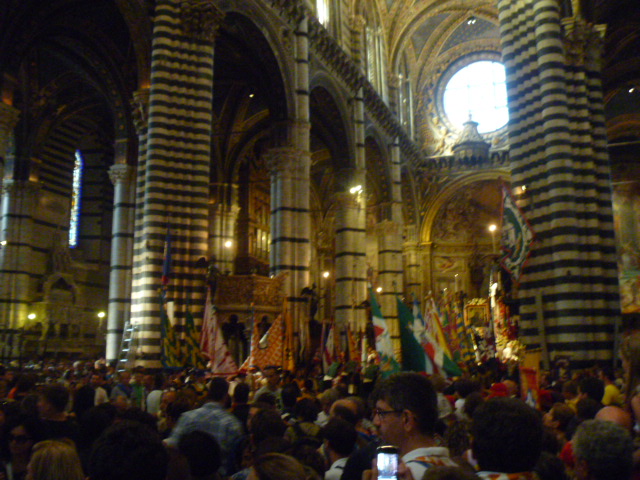
Only the idea of getting inside the Doumo was very thrilling. After a while, I finally figured out what that lady asked me. She said: are you one of the children’s parent (genitore) in the procession? I got embarrassed, and tried to get out of there. But it was too late. The procession already had reached its destination and nobody could get in or out. But my sense of guilt for an innocent incorrect answer, which I did not mean, was overcome by the splendor of the cathedral inside. I never had felt beauty in that way before. It was what Dr Dennis McNamara, in Mundelein seminary, means about a church building: a true attempt to represent heaven on earth! The sense of transcendence and flotation that gothic architecture gives us is so powerful in this place. I forgot for some time what I was doing there, what was going on. The cacophony of drums sounds, people talking among themselves, children screaming and the archbishop giving a speech nobody seemed to care were secondary in the scene. My whole being only could marvel on the beauty of the place, which brought up my nothingness and my need to worship.

When I came back to my senses, I saw the people around me making the sign of cross. The archbishop gave a final blessing. Then I remembered that the point for the people to come in procession was prayer and to make the candle offerings. But what kind of prayer was it? Silence was only obvious by its total absence. The dilemma of popular religiosity and right worship came up in my analytical mind.
It is a fact that the festivities were to honor the Assumption of Mary to heaven. However, the formal liturgical celebration is so out of people’s priorities. After everybody left the cathedral, I stayed for a little longer and then I witnessed the archbishop presiding on solemn vespers over a small group of faithful. Was not everybody else aware of the Mystery they were celebrating? I should be careful this time to answer that question. Il Palio of Siena is a secular feast with religious connotations. That is a fairer way to say it. It is almost close to what Christmas is becoming in America. Again, does it mean people neglect the Mystery? I would say no, it does not.

People in a secular society, even here in Italy I would say it is a secular society, are very much aware of the existence of the transcendent, the reality of God and the mystery that God is. The gospel is so in our midst. The majority, a great majority of us, just chooses not to confront our individual existences with the mystery of God. Because to acknowledge it formally is compelling and demands accountability to Him and to what we really are. It seems like it is better and easy to live in denial. The gospel, certainly, calls us out of the world and set us up apart in the liturgy where we face and take the deepest and most honest true of our existence: children of God destined to worship Him in heaven. This is what Mary is doing right now. The solemnity of her Assumption into heaven in body and soul is the mirroring of the mystery of Christ resurrection and the assurance of our hope to get into the same state. It is the solemnity of the restoration and elevation of the material.

All of what happened before the horserace is but a prelude, a time of anxiety and expectation. When at last the horses appeared and the race started, the crowd became delirious. The jockeys goaded their horses round the square three times and the people shout as if the town were about to fall. It only lasted 90 seconds. Then the winners run to the cathedral with the jockey on their shoulders to give thanks to their Lord and their Madonna. They celebrated the solemnity of the elevation of the material and with their hearts enhanced somehow acknowledged their final destiny. Simply they just resist embracing it once and for all.


Ceremony of the assignation of horses.

in the assignation of the horses, conspiracy theories are common
In order to get a place on the bleacher seats, one must have the time, money and negotiating skills


So, because I lacked of the above requirements I joined the masses in the center of the square for the race. From the center of the square, the race does not make much sense. It is over in less than 2 minutes, but who cares? I was part of the scene!

Children of the procession with the candles


I must respond to the Italian lady: No signora, I am not a genitore.

To seat there costs between 200 and 300 euros. Horses getting ready to start.

the weather? Splendid sunny warm summer afternoon

Stain glass in the Duomo


Cealing of the cathedral

Yes, the archbishop is talking. I must take this picture. I don't understand what he is saying anyway.


and finally, this is the PALIO, just freshly blessed.


Saturday, August 13, 2011

Oh Perfume of Freedom!

“Diego you need a cell phone. Next time when you come abroad, make sure you have a cell phone.” It was the statement of the week, made by one German classmate in broken Italian, obviously.  Really? Was the only thing I could think. I just nod like approving the sentence and to end the discussion. However, what my classmate did not is that I completely disagree with her.  It has been three weeks without a cell phone and I love it! I don’t think I will make an effort on having one here. It is real, pure and sophisticated freedom what I am experiencing without one; sweet smell of detachment.
What prompted the statement was the difficulty that, apparently, a group of students will have on finding me among the crowds in Piazza del Campo. The plan was to be together and enjoy the festivities of Il Palio di Siena over the long weekend ahead of us. Siena is in festa,  the Assumption of Mary is the excuse and there are not classes on Monday. Things have worked out well so far without a cell phone. It has made me more punctual and organized with time and plans. Nevertheless, I asked to myself questions like: How was life before cell phones?   How did people get together before and find each other? How one did pick up someone at the airport without a cell phone?  What did you do if you got a flat tire on the road? Those are just funny questions. Funny because we all know that we did not need cell phones to live and the questions sound like if we depend on cell phones for living. But it seems like we do. In fact, a full charged battery is one considerably increasing basic human need today, almost close to water.
But don’t get me wrong. I recognize that I have not established a social life, relationships or work here yet that will demand the “need” of a cell phone. Also I recognize, of course, the advantages of cell phones today and how easy life is because of the service they give us. With all technology and sciences, we should marvel on our capacity to invent things for the benefit of humanity. So, the point being here is to evaluate our use of cell phones, rather than to condemn them.
First of all, let’s define what a cell phone is and what it does. A cell phone is a device of instant communication among people. It gives us the convenience of getting quick and prompt answers to our questions or requests. We love them because instantaneity is the best thing we ever can experience.   Therefore, cell phones also carry out our emotions faster. Just think on the last time you stared at your phone full of frustration because the other doesn’t answer, or doesn’t call you back, or simple doesn’t reply to your text message. What about the phantom ringing or vibration. How many times have you heard your phone ringing or feel its vibration when in fact it did not? These are experiences that go beyond the basic service of the phone: to shorter distances for people to have a conversation about an important issue to be resolved at the moment.  
There is a need of connection among us, that’s true. The Lord wants us together and connected to Him and to each other. But the connection that cell phones give us involves certain addictive symptoms. Although we are still far away for the medical sciences to officially define addiction to cell phones, the characteristics of the behaviors we adopt when we are far away or with no access to the phone, are very similar to those of any recognized addictions. There is anxiety and nervousness. There is fear and loss of control. There is frustration even to the point of depression. That’s how the enemy takes advantage of us with something useful bringing us to a point of destruction. The addiction per se is not to the device itself but to what it does to me. It makes me feel important and popular. It develops stronger in me the illusion that the whole world should care about me. Also I dare to say that a ringing phone in Mass is the devil among us. There, the enemy accomplishes what he loves the best: to interrupt our prayer and break our connection to God.
A cell phone is a very useful thing, yes indeed! Yet, it is not essential for living. No having one here has made me appreciate more my only and true dependence on God alone. It is real, pure, sophisticated freedom; freedom from one less attachment. By going to celebrate Mass at the Sanctuary of Saint Catherine of Siena, I have felt how much her testimony has challenged me in a great deal. I feel so far away from my goal. But it is through little things like detachment from a cell phone how we get trained for heaven. We only can see the face of God when we have a free and total, undivided, whole heart for Him. But, it feels too much else in my heart still.
Fabulus view from the bench in the park where I sit in the afternoons to repeat Italian words like a parrot.

Front of the Society Dante Aligheri, the Italian language school

Inner court yard of the school.

Piazza del Campo is getting ready for the festivities of Il Palio this weekend. Barracaides, benches and the race track have been temporaly built.

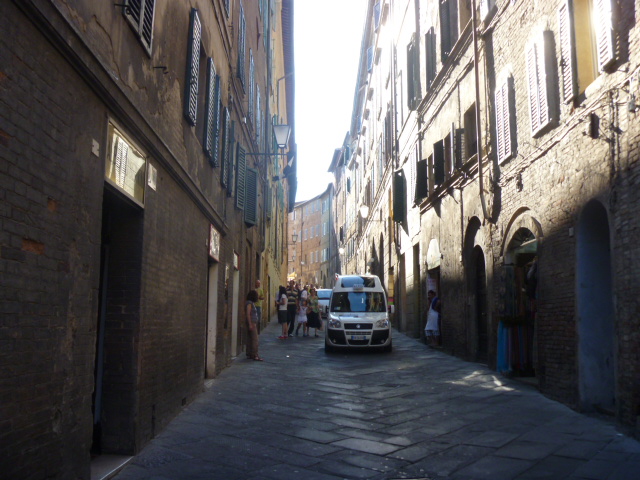
A good street view, coming back from school to my room

This is Via della Sapienza, where we live in Siena

Friday's full moon night in Piazza del Campo